Femtosecond lasers need precise, stable energy input. Without the right pump source, they lose performance. So why is 888 nm the industry favorite?
888 nm is preferred for femtosecond laser pumping because it provides better thermal management, higher beam quality, and improved efficiency compared to earlier options like 808 nm.
To understand this better, let’s break it down by exploring the principle, application, and why 888 nm wins in real-world femtosecond laser systems.
What is the principle of femtosecond laser1?
Femtosecond lasers are powerful tools—but their core mechanism is often misunderstood.
A femtosecond laser1 generates ultrashort light pulses with durations in the range of 10⁻¹⁵ seconds, achieved through mode-locking2 in gain media like Ti:sapphire or Yb-doped crystals.
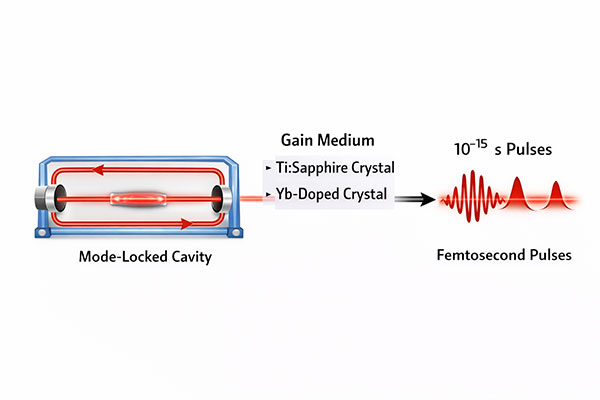
Dive Deeper: How Femtosecond Pulses Are Generated
The key principle behind femtosecond laser1s is mode-locking2. This is a technique that forces different frequencies (modes) within the laser cavity to oscillate in sync. When many frequencies add together in phase, they produce a train of very short pulses.
Types of Mode-Locking
| Method | Description | Used In |
|---|---|---|
| Active | Uses modulators to synchronize modes | Research setups |
| Passive | Uses saturable absorbers, no external control | Commercial systems |
Role of Pumping
To start lasing, femtosecond systems require a pump laser, often a diode laser. This pump injects energy into a gain medium (like Yb:KGW or Nd:YVO₄), which then emits the laser light.
Why Wavelength Matters
Gain media have narrow absorption spectra. For instance, Yb-doped crystals absorb best near 880–888 nm. If the pump light is off-target or spectrally wide, efficiency drops.
What does a femtosecond laser do?
They’re not just fast—they’re precise. And that opens up incredible applications.
Femtosecond lasers are used in micromachining, biomedical surgery, and nonlinear optics due to their precision, low thermal impact, and ultrafast interaction with matter.
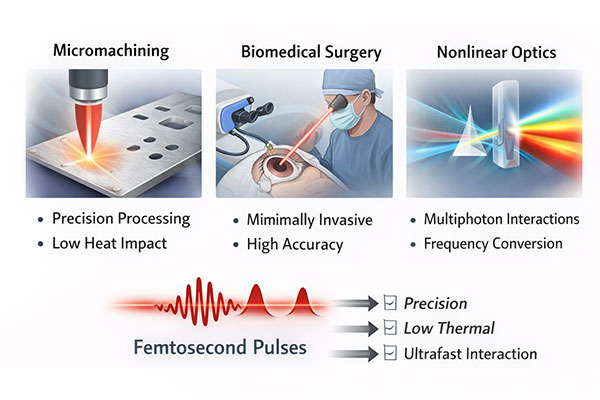
Dive Deeper: What Makes Femtosecond Lasers So Special?
These lasers remove material or modify surfaces with minimal heat damage—thanks to their ultrashort pulses. The energy is delivered so quickly that it doesn’t have time to diffuse into surrounding material.
Application Examples
| Industry | Use Case | Benefits |
|---|---|---|
| Medical | Eye surgery, dermatology | No scars, precise control |
| Electronics | OLED, semiconductor cutting | No burning, high precision |
| Scientific R&D | Spectroscopy, THz generation | Ultrafast dynamics exploration |
Physical Interaction: Ablation vs. Heating
Femtosecond pulses cause nonlinear absorption3. This means even transparent materials can be processed. Because the energy is so localized and fast, the surrounding areas remain untouched. Traditional nanosecond or CW lasers can’t do that.
Result: Cold Processing
"Cold ablation" is the dream of many engineers. Femtosecond lasers come close to it. This makes them ideal for biomedical and high-precision industrial applications.
Why 888 nm Is Preferred in Femtosecond Laser Pumping?
This is the heart of the discussion—and yes, the difference is not just a number.
888 nm provides narrower spectral width4, better wavelength locking, and reduces thermal effects in gain media5 like Nd:YVO₄6 or Yb:KGW, outperforming 808 nm in femtosecond laser applications.
Dive Deeper: 888 nm vs. 808 nm—What Changed?
Early solid-state femtosecond lasers used 808 nm diode lasers to pump Nd:YAG. But newer gain crystals (Nd:YVO₄6, Yb:KGW) work better when pumped near 880–888 nm.
Performance Comparison
| Parameter | 808 nm | 888 nm |
|---|---|---|
| Absorption Peak | Off-resonance for YVO₄ | Peak resonance for YVO₄ |
| Thermal Load | Higher | Lower |
| Spectral Width | Broad | Narrow (with wavelength locking) |
| Efficiency | Moderate | Higher |
| Beam Quality | Lower | Higher |
VBG Locking Advantage
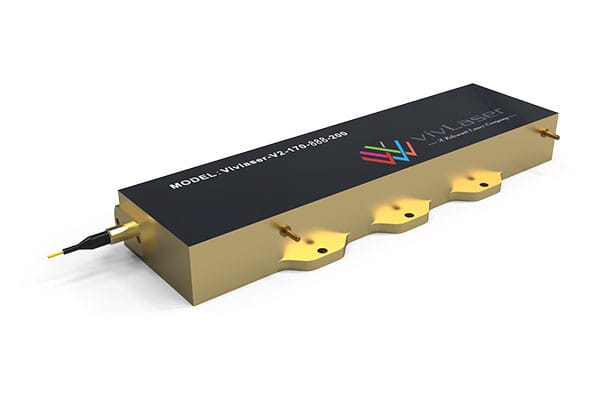
活力激光’s 888 nm diode modules integrate VBG (Volume Bragg Grating)7 technology. This locks the output wavelength within ±0.5 nm, which is ideal for crystals with narrow absorption bands.
- Thermal Lens Reduction: Less heating means better beam quality
- Harmonic Generation: Improved 2nd/3rd harmonic conversion due to beam stability
- Longer Lifespan: Less thermal stress improves diode life
Industry Shift: From 808 to 888
With femtosecond systems demanding higher performance, 888 nm quickly replaced 808 nm for pumping applications. 活力激光’s high-power 888 nm series (30W to 175W) are used by leading laser brands like Han’s Laser and Inno Laser.
Real-World Example: Nd:YVO₄6 + 888 nm
Nd:YVO₄6 has a sharp absorption peak at ~888 nm. By matching this precisely and using narrow-band pumping, you reduce quantum defect and avoid thermal issues—directly improving system output and reliability.
Conclusion
888 nm offers the best match for modern femtosecond lasers—high absorption, low thermal effects, and stable output make it the top choice for pumping solid-state ultrafast systems.
-
Explore the diverse applications of femtosecond lasers in fields like medicine and manufacturing, showcasing their transformative potential. ↩ ↩ ↩
-
Understanding mode-locking is crucial for grasping femtosecond laser technology; this link will deepen your knowledge of its mechanics. ↩ ↩
-
Learn about nonlinear absorption to grasp how femtosecond lasers can process materials without damaging surrounding areas, a key to their effectiveness. ↩
-
Understanding the advantages of narrower spectral width can enhance your knowledge of laser performance and applications. ↩
-
Learning about thermal effects in gain media is essential for optimizing laser performance and longevity. ↩
-
Discovering the properties of Nd:YVO₄ will deepen your understanding of its significance in laser technology. ↩ ↩ ↩ ↩
-
Exploring VBG technology will reveal its critical role in enhancing laser stability and efficiency. ↩