Metal parts fail. Surfaces wear out. Traditional repair methods waste material and time. Manufacturers need faster, more precise solutions to restore high-value components.
Laser Metal Deposition (LMD)1 is a laser-based additive manufacturing process that melts metal powder with a focused laser and deposits it layer by layer onto a substrate, forming strong metallurgical bonds for repair, coating, or manufacturing metal components.
Laser manufacturing technologies continue to evolve. Among them, Laser Metal Deposition has become a key solution for industrial repair, surface engineering, and additive manufacturing. Understanding how this process works helps manufacturers choose the right technology for efficiency, cost control, and performance.
What Is Laser Metal Deposition and How Does It Work?
Manufacturers often struggle with expensive component replacement. Many metal parts fail only in localized areas. Replacing the entire component increases downtime and cost.
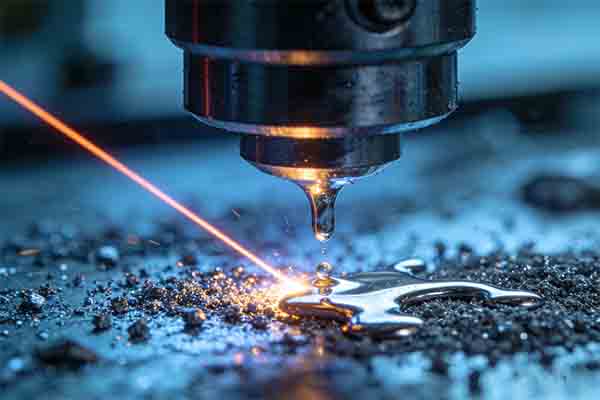
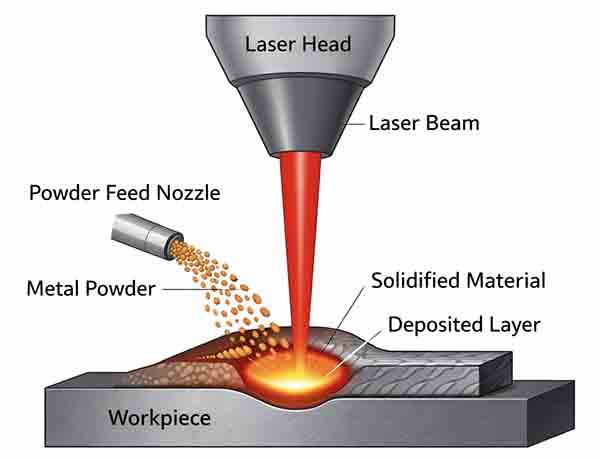
Laser Metal Deposition works by using a high-power laser to create a melt pool on the metal surface while metal powder or wire is simultaneously fed into the pool, forming a new metallurgically bonded layer2.
Understanding the Basic Principle of LMD3
Laser Metal Deposition belongs to the Directed Energy Deposition (DED)4 family of additive manufacturing technologies. The process builds material by depositing metal directly into a laser-generated melt pool5.
A typical process follows these steps:
1. A high-power laser beam focuses on a small area of the workpiece.
2. The laser energy melts the surface and forms a molten pool.
3. Metal powder or wire is injected through a nozzle.
4. The material melts instantly and mixes with the molten substrate.
5. The melt pool solidifies as the laser moves forward.
6. Layers accumulate to create a coating or 3D structure.
This direct deposition process allows manufacturers to rebuild damaged surfaces or add new features to existing components.
Core Characteristics of the LMD Process
Laser Metal Deposition offers several engineering advantages. These advantages explain why the process is widely used in industrial manufacturing.
| Feature | Description |
| Metallurgical bonding | Deposited material bonds directly with the substrate |
| Controlled heat input | Laser energy is localized and precise |
| Minimal distortion | Reduced heat-affected zone compared with welding |
| High flexibility | Works on both new parts and existing components |
| Large part capability | No enclosed build chamber required |
Another important advantage is that LMD systems can be integrated into robotic platforms or CNC machines. This integration allows manufacturers to process large components that cannot fit inside powder-bed additive systems.
Role of High-Power Semiconductor Lasers
The laser source is the core energy supplier in LMD systems. Modern systems increasingly use high-power semiconductor lasers due to their efficiency and stability.
高功率半导体激光器6 provide several benefits:
· high electro-optical efficiency
· stable output power
· compact design for industrial integration
· excellent absorption for many metal materials
Manufacturers such as 活力激光 specialize in semiconductor laser technologies that support applications including laser cladding, additive manufacturing, and surface treatment.
These characteristics make diode laser modules highly suitable for industrial deposition systems.
What Materials Can Be Used in Laser Metal Deposition?
Many manufacturing technologies are limited to a narrow range of materials. This limitation restricts industrial adoption.
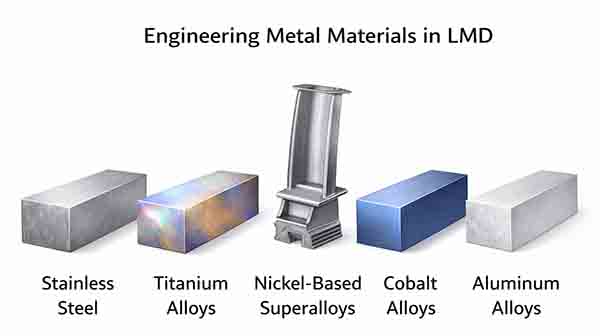
Laser Metal Deposition supports a wide range of engineering metals, including stainless steel, titanium alloys, nickel-based superalloys, cobalt alloys, and aluminum alloys.
Common Metals Used in LMD
One of the key strengths of LMD technology is its ability to process high-performance industrial materials.
The most frequently used materials include:
| Material | Typical Application |
| Stainless steel | Corrosion-resistant coatings |
| Nickel-based superalloys | Aerospace turbine repair |
| Titanium alloys | Aerospace structures |
| Cobalt alloys | Wear-resistant surfaces |
| Aluminum alloys | Lightweight structures |
These materials are widely used in industries where performance, durability, and thermal resistance are critical.
For example, nickel-based superalloys are commonly used in turbine blades7. These components operate at extremely high temperatures. Laser Metal Deposition allows manufacturers to rebuild worn blade edges without replacing the entire component.
Functionally Graded Materials
Another advantage of LMD is the ability to create functionally graded materials (FGMs).
In traditional manufacturing, a component typically uses only one material. However, different areas of a component may require different properties8 such as hardness, corrosion resistance, or thermal conductivity.
LMD allows engineers to gradually change material composition during the deposition process.
This approach offers several engineering benefits:
· improved thermal resistance
· enhanced wear protection
· reduced thermal stress between layers
For example, a steel component may require a wear-resistant cobalt alloy surface. LMD can deposit cobalt alloy gradually over the steel substrate. This transition reduces cracking risk and improves structural stability.
Powder Quality and Process Stability
Material quality also plays a critical role in deposition performance.
Important powder parameters include:
| Parameter | Importance |
| Particle size distribution | Affects powder flow stability |
| Powder purity | Prevents contamination |
| Flowability | Ensures stable feeding |
| Shape uniformity | Improves melting efficiency |
Stable powder delivery ensures consistent melt pool formation and uniform layer thickness.
Modern deposition systems also use real-time monitoring to maintain stable process conditions.
Where Is Laser Metal Deposition Used in Industry?
Many industries operate expensive equipment that must remain in service for years. Traditional repair methods are often slow and inefficient9.
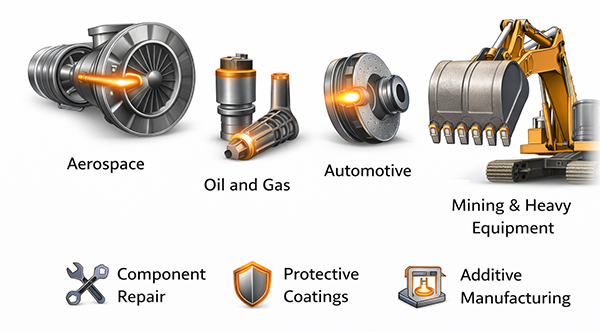
Laser Metal Deposition is widely used in aerospace, oil and gas, automotive manufacturing, mining equipment, and heavy machinery for component repair, protective coatings, and additive manufacturing.
Aerospace Industry
Aerospace components are extremely expensive and require strict performance standards.
LMD is frequently used to repair:
· turbine blades
· engine casings
· landing gear components
Instead of replacing entire parts, engineers rebuild damaged regions with laser deposition. This approach reduces maintenance costs while maintaining structural performance.
Oil and Gas Industry
Oilfield equipment operates in harsh environments with severe wear and corrosion.
Typical components treated with LMD include:
· drilling tools
· pump shafts
· valves
· pipeline components
Laser deposition coatings significantly extend service life in abrasive environments.
Automotive Manufacturing
Automotive manufacturers are increasingly adopting laser deposition technologies.
One example is brake disc coating. High-speed laser metal deposition can apply thin wear-resistant layers on brake discs. This technology reduces particulate emissions and improves durability.
Mining and Heavy Equipment
Mining machinery operates under extreme mechanical stress.
Components such as excavator teeth, crusher parts, and drilling tools experience constant abrasion.
Laser Metal Deposition allows manufacturers to apply wear-resistant coatings that dramatically increase component lifespan.
Integration With Semiconductor Laser Technology
High-power semiconductor lasers10 play an important role in enabling these industrial applications.
Advanced diode laser modules provide:
· stable optical output
· compact integration into industrial equipment
· high power scalability
Semiconductor laser manufacturers11 such as 活力激光 provide laser modules used in 工业激光加工ing systems including laser cladding and additive manufacturing equipment.
These technologies support industries ranging from 工业激光加工ing to medical and scientific applications.
Conclusion
Laser Metal Deposition enables efficient repair, coating, and additive manufacturing of metal components with strong metallurgical bonding and high flexibility, making it a key technology for modern industrial manufacturing.
-
Understand the concept and industrial uses of laser metal deposition technology. ↩
-
Explain why deposited layers strongly bond with the base metal. ↩
-
Learn how LMD forms material layer by layer. ↩
-
Understand the technology category behind LMD ↩
-
Explains the core melting zone in LMD. ↩
-
Understand what high-power semiconductor lasers are and where they are used. ↩
-
Learn about heat resistance in turbine blade materials. ↩
-
Understand how hardness affects durability and wear resistance. ↩
-
Understand why new repair technologies are needed. ↩
-
Understand how semiconductor lasers power 工业激光加工ing systems. ↩
-
Learn how diode lasers enable modern manufacturing. ↩