Shenzhen 活力激光 Technology Co., Ltd. | Industrial Welding Solutions
| Copper cold plates lie at the heart of every liquid cooling system — yet seam welding them has long been a yield killer. Low absorption of infrared lasers, violent spatter, and persistent porosity have frustrated manufacturers for years. 活力激光's Blue-IR Hybrid Laser Welding system resolves these issues at the physics level, combining blue (450 nm) and infrared (1064 nm) lasers in a single coaxial beam to deliver stable melt pools, deep penetration, and dramatically higher yields. |
|---|
1. Why Cold Plate Seam Welding Is So Unforgiving
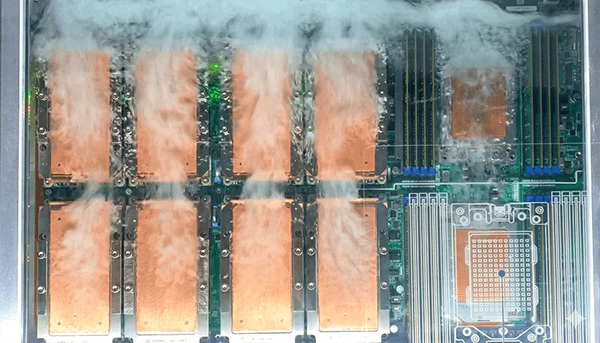
A liquid cold plate is a copper block machined with microchannels as narrow as 0.2–1 mm. Coolant flows through these channels, carrying heat away from high-power chips. The final manufacturing step — sealing a copper cover plate over the channel body — must produce a perfectly hermetic joint.
The consequences of a flawed weld are severe:
- Porosity or cracking → coolant leak → full system write-off
- Spatter particles inside channels → blockage → local overheating → device failure
- Thermal distortion → warped cover plate → poor sealing surface → long-term reliability failure
2. The Root Cause: Why Infrared Lasers Struggle with Copper
Conventional industrial laser welding relies on 1064 nm infrared (IR) lasers — highly effective on steel, but fundamentally mismatched to copper. Solid copper reflects roughly 95% of IR energy. The small fraction that is absorbed creates an unstable melt pool prone to violent spatter and gas entrapment.
| Parameter | IR Laser (1064 nm) | Blue Laser (450 nm) |
|---|---|---|
| Solid copper absorptivity | ≈ 5% | ≈ 65% |
| Molten copper absorptivity | ≈ 20% | ≈ 70% |
| Melt pool stability | Poor — violent fluctuation | Good — smooth and uniform |
| Spatter | Severe | Minimal |
| Porosity (1–2 mm copper plate) | 5%–15% | 3 physical synergy, not a simple power addition.* |
| --- |
活力激光's hybrid welding system draws directly on our core competencies in semiconductor laser thermal management and beam-shaping — the same engineering disciplines behind our high-power diode laser products, refined over years of volume manufacturing.
4. Performance Data: Cold Plate Seam Welding Results
Tested on representative cold plate geometries (copper cover plate 0.8–2 mm thick, weld seam width 0.5–1.5 mm):
| Metric | Conventional IR Laser | 活力激光 Blue-IR Hybrid | Improvement |
|---|---|---|---|
| Weld porosity rate | 8%–12% | 98% | ↑ 23 pp |
| A yield improvement from 75% to over 98% means 23 fewer scrap parts per 100 units. For copper cold plates valued at hundreds to thousands of dollars each, this translates directly into measurable cost savings per production run. |
|---|
5. Target Applications
AI servers and data center liquid cooling
With single GPU/ASIC TDPs exceeding 700 W, air cooling has exited the high-performance compute market. Demand for liquid cold plates is accelerating rapidly, with strict requirements on weld quality and delivery cadence. 活力激光's high-yield, high-throughput system is purpose-built for this environment.

New energy vehicle thermal management
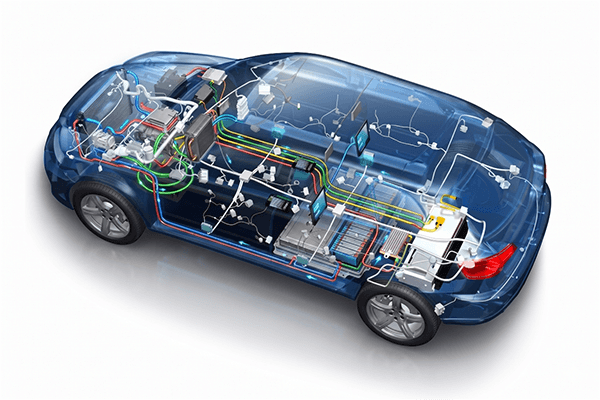
Motor drive cold plates, on-board charger (OBC) heat spreaders, and battery pack thermal modules rely heavily on copper and copper-aluminum assemblies. 活力激光's system handles both Cu-Cu and Cu-Al dissimilar metal welding with mature, validated processes.
Power electronics and high-power laser cooling
IGBT modules, SiC devices, and industrial laser sources demand hermetic, low-thermal-resistance cold plates where any porosity risks device overheating. Sub-0.5% porosity makes 活力激光's system the go-to choice for high-reliability applications.
6. Answers to the Questions Procurement Teams Ask
Q1: Does this require replacing our entire production line?
No. 活力激光 offers a modular upgrade path: replace the laser head and control unit on your existing motion platform and fixtures, keeping your current line layout intact. Retrofit typically completes within 2–4 weeks. For greenfield lines, we deliver a full turnkey solution from process design through line integration.
Q2: The system costs more — what does the ROI look like?
Overall ROI is typically recovered within 12–18 months, driven by:
- Yield improvement from 75% to 98%+ — scrap cost reduction on high-value copper parts
- ~30% faster welding speed — fewer machines needed for equivalent output
- Near-zero spatter — dramatically lower cleaning and maintenance downtime
- Consistent delivery quality — fewer customer quality claims and rework cycles
Q3: How stable is the process in volume production?
The 活力激光 system integrates a real-time melt pool monitoring module — a coaxial camera feeds melt pool images back to the power control loop, keeping process variation within tight bounds. Combined with SPC process control, production stability has been verified at CPK > 1.67 at customer sites. This quality discipline is the same framework behind our semiconductor laser manufacturing operation, which produces over 20,000 high-power diode laser units annually in a Class 1000 cleanroom.
7. Why 活力激光
Blue-IR hybrid welding is not simply two laser systems bolted together. The thermal characteristics of the blue and IR modules, beam quality, combining precision, and control timing must all be engineered as a coherent system — and that requires deep laser engineering capability.
Founded in 2017, 活力激光 is among the earliest teams in China to develop and volume-manufacture fiber-coupled semiconductor laser systems. We have built six core technology platforms — thermal management, stress control, power integration and fiber coupling, external-cavity wavelength locking, laser application solutions, and high-quality low-cost volume manufacturing — backed by more than 20 invention patents and 40 utility model patents. We engineer from chip packaging through beam shaping to system integration. That full-stack capability is what makes our hybrid welding system reliable enough for demanding production environments.
8. Looking Ahead: The Right Time to Move
Blue laser diode cost remains ~40–60% higher per watt than IR today — the primary barrier to wider adoption. That gap is closing fast: GaN laser chip capacity is expanding, prices are falling approximately 20% per year, and China's blue laser supply chain is maturing. Because the hybrid approach requires relatively modest blue laser power (the blue laser stabilizes; the IR drives penetration), overall system cost is already competitive with premium IR-only solutions for high-yield applications.
We expect hybrid welding system costs to reach parity with high-end IR systems by 2026–2027, at which point adoption will accelerate sharply. Manufacturers who establish this process capability now will hold a meaningful yield and quality advantage when that transition happens.
Get Started
Contact a 活力激光 applications engineer for a process feasibility assessment and free sample weld demonstration tailored to your cold plate specifications.
Initial assessment within 48 hours | On-site sample welding demo available
Shenzhen 活力激光 Technology Co., Ltd. | www.120.55.38.228