u003cstrongu003eKey Takeawaysu003c/strongu003e
Glass internal engraving typically uses solid-state lasers such as Nd:YAG, green lasers, and ultrafast lasers
Nd:YAG (1064 nm) is the most widely used due to deep penetration and stable performance
Green lasers offer higher absorption and finer detail in certain materials
Picosecond lasers provide superior precision with minimal thermal effects
Pump source stability directly impacts engraving quality, especially in solid-state laser systems
[lwptoc]
Glass is transparent and difficult to process. Many laser types1 cannot interact with it effectively. This creates confusion when selecting the right laser system for internal engraving.
The most common lasers for glass internal engraving2 are Nd:YAG (1064 nm), green lasers (532 nm), and picosecond lasers, all of which enable precise energy focusing and internal modification.
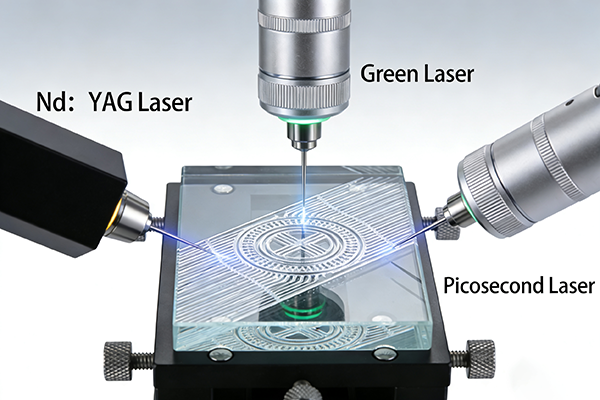
To choose the right system, you need to understand how each laser type interacts with glass and what role the pump source plays.
Why Is Nd:YAG (1064 nm) the Most Common Laser?
Many buyers struggle to balance cost, performance, and reliability. Choosing the wrong laser increases system risk.
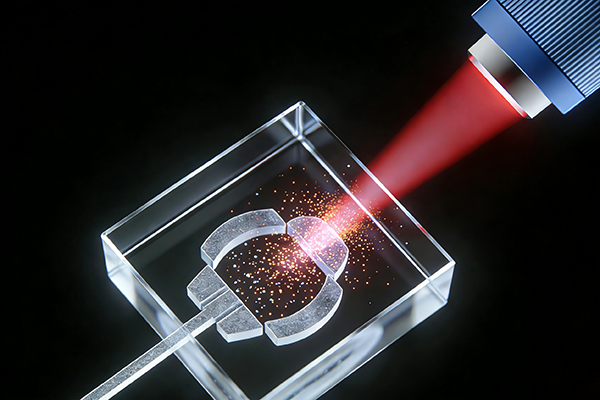
Nd:YAG (1064 nm) lasers 3are widely used because they provide deep penetration, stable output, and compatibility with mature solid-state laser systems.
Deep Explanation
Basic Characteristics
Nd:YAG is a solid-state laser operating at 1064 nm. It is typically pumped by semiconductor laser diodes.
| Parameter | Value |
| Wavelength | 1064 nm |
| Laser type | Solid-state |
| Pump source | Semiconductor laser |
| Operation mode | Pulsed |
Why It Works for Glass
Glass has low absorption at 1064 nm under normal conditions. This allows:
- Deep beam penetration
- Internal focusing without surface interaction
When focused, the energy density becomes high enough to trigger optical breakdown.
Advantages
- Mature and stable technology
- Lower system cost
- High reliability
- Suitable for industrial use
Limitations
- Larger heat-affected zone compared to ultrafast lasers4
- Lower precision than picosecond systems
Role of Pump Source (Important for You)
Nd:YAG lasers rely on 半导体激光泵浦源. The performance of the pump source directly affects:
- Output stability
- Pulse energy consistency
- Thermal behavior
High-quality semiconductor pump sources5 with stable wavelength and strong thermal management are critical to ensure consistent engraving results.
Practical Insight
For most commercial 3D crystal engraving systems, Nd:YAG remains the best balance between cost and performance.
Engineering Check
“Nd:YAG lasers rely on semiconductor pump sources to generate stable 1064 nm output.”
The pump source determines energy stability and overall system reliability.
“Nd:YAG lasers cannot be used for internal glass engraving.”
They are the most commonly used lasers for this application.
When Are Green Lasers Used for Glass Engraving?
Nd:YAG6 works well, but sometimes higher precision is required. This creates demand for alternative wavelengths.
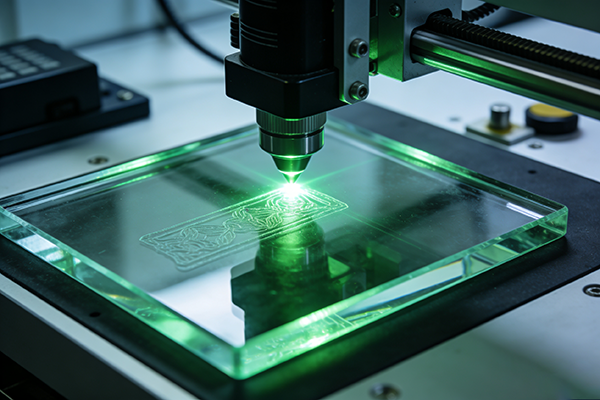
Green lasers (typically 532 nm) 7 are used when higher absorption and finer feature resolution are needed in specific materials.
Deep Explanation
What Is a Green Laser?
Green lasers are usually generated by frequency doubling (SHG) of Nd:YAG lasers:
- Fundamental wavelength: 1064 nm
- Output wavelength: 532 nm
Interaction with Glass
Compared to 1064 nm:
- Slightly higher absorption
- Better interaction in some glass types
- Improved feature visibility
Advantages
- Smaller focal spot size
- Higher precision engraving
- Better contrast in some materials
Limitations
- Higher system complexity
- Lower efficiency due to frequency conversion
- Higher cost
Engineering Trade-off
| Factor | Nd:YAG (1064 nm) | Green (532 nm) |
| Penetration | High | Medium |
| Precision | Medium | Higher |
| Cost | Lower | Higher |
Role of Pump Source
Even green lasers depend on Nd:YAG systems. Therefore:
- Pump diode stability still matters
- Thermal control affects conversion efficiency
- Wavelength stability impacts output quality
This means pump source quality remains a core factor in system performance.
Practical Insight
Green lasers are used when visual quality and fine detail matter more than cost.
Engineering Check
“Green lasers are typically generated by frequency doubling of 1064 nm solid-state lasers.”
Second harmonic generation converts infrared light to visible green light.
“Green lasers eliminate the need for a pump source.”
They still rely on diode-pumped solid-state laser systems.
Why Are Picosecond Lasers Used for High-End Engraving?
Standard lasers may cause thermal damage. High-end applications require better precision and minimal heat effects.
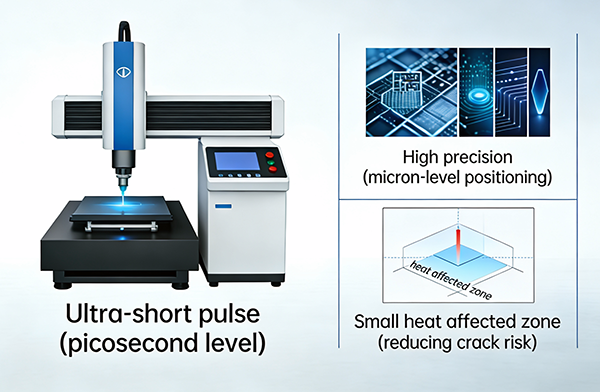
Picosecond lasers8 are used because they deliver ultra-short pulses that reduce thermal impact and enable extremely precise micro-structuring.
Deep Explanation
What Is a Picosecond Laser?
A picosecond laser emits pulses in the range of:
- 10⁻¹² seconds
This creates extremely high peak power with minimal heat diffusion.
Interaction Mechanism
Compared to nanosecond lasers:
- Energy is delivered faster
- Heat does not spread
- Material modification is cleaner
Advantages
- Minimal heat-affected zone9
- Higher precision micro-point formation
- Better control of micro-fractures
Limitations
- High system cost
- Complex system design
- Lower throughput in some cases
Engineering Comparison
| Feature | Nanosecond | Picosecond |
| Pulse duration | Longer | Ultra-short |
| Heat effect | Higher | Minimal |
| Precision | Medium | Very high |
System Requirements
Picosecond systems require:
- High-end optics
- Precise synchronization
- Stable pump source
Even in ultrafast systems, 半导体激光泵浦源 are still critical for solid-state architectures.
Practical Insight
Picosecond lasers are ideal for:
- High-end optics
- Scientific research
- Precision photonics applications10
Engineering Check
“Shorter pulse duration reduces thermal diffusion and improves engraving precision.”
Ultrafast pulses confine energy deposition in time and space.
“Picosecond lasers are always the best choice regardless of cost or application.”
They are only justified when high precision outweighs cost considerations.
My insight
The choice of laser for glass internal engraving11 is not fundamentally about wavelength—it is about how stable and controllable the laser energy delivery is at the focal point over time.
In real industrial environments, engraving quality is determined by:
- Pulse-to-pulse energy consistency
- Thermal stability of the laser system
- Reliability of the semiconductor pump source
Because regardless of whether you use Nd:YAG, green, or picosecond lasers, they all rely on precise energy deposition to create uniform micro-points.
Bottom Line for B2B Buyers:
If the laser system cannot guarantee long-term energy stability (not just peak specs), you will see inconsistent engraving quality, especially in batch production—making the pump source and thermal design more critical than the laser type itself.
- This resource provides detailed insights into the most effective laser types for glass engraving, helping you make an informed decision based on their unique properties and applications. ↩︎
- This resource provides detailed insights into selecting the optimal laser system for glass internal engraving, focusing on key factors like laser types and pump sources. ↩︎
- This link will provide insights into why Nd:YAG lasers are preferred for glass engraving, focusing on their performance and reliability. ↩︎
- This query explores the impact of Nd:YAG lasers’ larger heat-affected zone on applications, helping you understand their limitations and suitability for specific tasks. ↩︎
- This link will explain the role of semiconductor pump sources in ensuring the stability and efficiency of Nd:YAG laser systems. ↩︎
- This resource provides a detailed comparison of Nd:YAG and green lasers, highlighting their performance, cost, and suitability for specific engraving tasks. ↩︎
- This resource provides a detailed comparison of green lasers (532 nm) with Nd:YAG lasers, highlighting their benefits for precision and visual quality, as well as their limitations like higher cost and complexity. ↩︎
- This resource provides a detailed comparison of picosecond lasers with nanosecond lasers, highlighting their precision, minimal heat effects, and ideal use cases in advanced engineering fields. ↩︎
- This keyword highlights a key advantage of picosecond lasers, making it essential for understanding their application in high-precision engraving. ↩︎
- This keyword points to the specific industries and uses where picosecond lasers are most effective, offering valuable insights for professionals and researchers. ↩︎
- This resource provides essential insights into the critical aspects of laser energy stability and system reliability for consistent glass engraving quality in industrial settings. ↩︎